
In a relationship, you need somebody who’s going to call you out, not somebody who’s going to let everything slide. You need somebody who doesn’t want to live without you, but can. Not somebody that is dependent, but somebody who is stronger with you. A relationship is two people, not one
Tag: words
What do ruined people do? Weird shit. This seems to be the consensus of psychoanalysts as far back as Freud and Jung; the traumatized self creates, out of necessity, a system of self-care that is keen to avoid repeat trauma. This makes change difficult; it makes people who’ve had part of their psyches destroyed by unmanageable emotions push people and emotions away, create obstacles, generate unnecessary drama.
“Grief Magic” by Emily Rapp, The Rumpus
I dug through my entire archive to find this quote, scrolling back a few years, because this phrase stuck with me as I find myself doing “weird shit”. I needed to read this essay.
(via aranrhod)
When a person tells you you hurt them, you don’t get to decide you didn’t.
Louis C.K. (via classically-incomplete)
My great-grandmother was pregnant for over a decade of her life.
She was pregnant at least fifteen times, had over a dozen children. Raised all of them in a big rambling farmhouse in central Pennsylvania.
And I thought about her this afternoon, lying in bed with my spouse after my lazy weekend nap, snuggling him and burying my nose in his hair, taking deep breaths of the scent of his skin. This man who is the center of my universe, my best friend, one of two reasons why I literally decided I had to live and kept fighting through the pain after surgery when I really wanted to just let go and die: I held him closer and I thought of her.
I thought of how family myth tells us that after a decade of being pregnant pretty much constantly, she kicked my great-grandfather out of their house. How she made him go live in his workshop, and he came to the house for meals and to check in.
But he slept in his workshop.
Not because she didn’t love him, but because she did.
She loved him, and if they slept in the same bed together, these two people who had crossed an ocean together, had built a life together after getting out of Poland together, they’d have sex. And because cheap, reliable, universal birth control wasn’t available then, and she was terribly fecund, apparently, she’d become pregnant again, inevitably.
My great-grandmother was TIRED of being pregnant.
So she kicked her love out of the house, and he went. He lived in his workshop, on their farm, and they stopped sleeping together, in every sense of the word. My father tells me he remembers as a child his grandfather sitting outside his workshop, leaning back on his chair, and looking up at the house in which he couldn’t sleep anymore, just… sad.
They missed each other desperately from across the yard.
I listen to @adhocavenger sleep, to the sound of his breathing, a sound that’s as familiar to me as my own heartbeat, and I can’t imagine having to sleep away from him for long. To have to separate myself from my spouse or to have to completely eschew having the kind of sex they obviously enjoyed having. To not have him close enough at night that I can curl up to him and breathe in the scent of his skin.
And that, I think, is the sort of thing that I think maybe I take for granted. That I know I can be secure in the knowledge that I can have sex with my spouse when I want to, and not have a baby.
The personal is political. I do not want our country to continue to slide backward on reproductive freedom. I do not want us to lose our freedom, threatened and small as it may be.
There are a thousand small tragedies that we talk about from the Olde Days. The unwanted baby of the unmarried lass, of course.
But my heart breaks tonight for the story I was told as a child, of the lovingly married couple who had to sleep apart because she was just damn tired of being pregnant.
Because she’d been pregnant for a DECADE of her life.
Thank you for sharing this. I had never considered that aspect of the birth control revolution.
My great-grandmother also had twelve children and I’ve been thinking about that a lot recently as I debate having a second. Because I have a choice. We have options. She didn’t.
We have the ability to stop this from ever becoming commonplace again… we must use that ability and make it readily and cheaply available to every person on the planet or we have wasted the last 100 years of social progress
Here is what they don’t tell you:
Icarus laughed as he fell.
Threw his head back and
yelled into the winds,
arms spread wide,
teeth bared to the world.(There is a bitter triumph
in crashing when you should be
soaring.)The wax scorched his skin,
ran blazing trails down his back,
his thighs, his ankles, his feet.
Feathers floated like prayers
past his fingers,
close enough to snatch back.
Death breathed burning kisses
against his shoulders,
where the wings joined the harness.
The sun painted everything
in shades of gold.(There is a certain beauty
in setting the world on fire
and watching from the centre
of the flames.)
the sanctity of platonic male friendship
i’ve seen a lot of variations on this argument pass my dash ever since that cacw empire article came out, so i’m just gonna say it: it is not harder and better and somehow more purer to portray a platonic male friendship on screen than it is to make the relationship romantic. it’s not. the history of media is full of guys who love each other and would do anything for each other and then go home to their wives, because well obviously they’re not gay.
“romance is just an easy shorthand for intimacy and trust.”
please. please send these easy shorthand gay relationships my way. what universe do you live in that gay people can hook up easily on-screen and the audience reaction is “what a cop-out, they’re just doing it to avoid developing their friendship.”
listen. heterosexual romance is often an easy shorthand for intimacy and trust. this works because there’s an expectation – both on part of the filmmaker and the presumed audience – that heterosexual romance is normal and part of the background radiation of everyday life. and anyone makes a movie where the male and female leads hook up, without much build-up or development of their relationship, they then strengthen that expectation in a self-perpetuating feedback loop.
gay romance does not have the same cultural history. the default assumption is in fact that same-sex leads will not hook up unless they live in the gay/lesbian genre. platonic male friendship is, in fact, the easy way out.
it’s absolutely homophobic to say a gay romantic relationship would somehow lessen a bond of friendship. and i mean this in the kindest of ways, because it’s not the same kind of homophobia that leads to gay people being physically attacked, or laws being written to actively restrict people’s rights for the fact of being gay. it’s a low-grade, pervasive homophobia that results when the speaker doesn’t conceptualize gay people as a part of a normal, everyday milieu. that a character being gay has to be narratively justified in some way (as if gay people around the world don’t have to justify their right to exist every single day!); that a gay relationship is somehow “pandering” and “inorganic”, because the normal, natural – straight – audience could never really relate to a gay relationship.
look. we are all shaped by cultural expectations. it doesn’t make someone a bad person if their mental conception of “an intense relationship between two guys” defaults to “friendship” instead of “romance”. but responding to any challenges to that paradigm by extolling the virtues of same-sex friendship and ignoring the long history of gay relationships in media being censored and sanitized and othered? yeah. that’s homophobic.
Agreed. If it were really so “easy” to say they were lovers, it would have been done already.
The use of the word “brotherhood” as a counter to gay relationships has really started to bother me.
Brotherhood has become a more polished “no homo,” apparently to the point that two male characters can have a “love story” on screen and still be totally straight. They could say the characters are “just friends,” but they have to go all the way to “brothers” to make sure the relationship can be as emotional as they want with no gay repercussions. When I see this, I feel like it sets up a dichotomy of queer vs. familial, where “brotherly love” is held up as the safe, natural reading, and a queer reading becomes even more perverse by contrast.
That post you reblogged is shitty though because it is important to acknowledge if ship dynamics are abusive or unhealthy because not everyone in fandom is an adult who can tell the difference.
Oh FFS.
I’m probably going to regret this when I’m more awake and haven’t been sitting in the ER for three hours but you caught me in a fighting mood, so. It is what it is.
I’ve been lowkey annoyed at this attitude that seems to be taking over fandom for a while, and this is just the straw that broke it. If you think it’s important to deconstruct the relationship critically and examine why it’s a flawed relationship and/or an abusive dynamic, knock yourself out. That is your perogative as a participant in fandom and I’m sure there are plenty of people that would love to read your meta. But at the point you start coming at other people about how they consume and enjoy media, you’ve crossed the line from litcrit into concern trolling.
It is not my job to protect people from the content of the media or the internet. I am not their mommy. If you consume something that makes you uncomfortable, then sure, talk about what made you uncomfortable. But don’t come in my inbox and tell me I have a responsibility to put up disclaimers beyond tagging my work. As a fandom author, your ONLY responsibility is to make sure the work you’re posting belongs to you and that you tag it accurately so readers know what they’re getting into (CNTW included). If a reader wants to talk to me directly about how something I wrote is not working for them or makes them uncomfortable or triggers them and needs a warning, that’s fine and I welcome it.
But it’s not okay to come up on someone and tell them it’s their responsibility to dissect what they enjoy as escapism. If you want to do that it’s on you. Personally, as someone who enjoys the fascinating and complicated depiction of dysfunctional relationships IN FICTION, I don’t want to take the time to do that. Fandom is the arena I come into to escape having to be on point about real world issues. It’s not the place I want to spend time examining social justice issues, because I do enough of that IRL.
And on an unrelated but equally annoying note, nobody has to disclose their personal trauma or history for fandom to decide they’re “allowed” to write about certain things. It’s super fucking rude to either assume something about a person’s background or, worse, ASK them about it (because wow no, if someone wants to talk to you that’s one thing but asking is fucking invasive and it’s not any of your damn business).
So yeah, talk all you want in your own meta on your own blog about how you dislike XYZ ship for whatever reason, but it’s nobody’s responsibility but yours to police what you consume and make sure it’s “problem free.”
Hell, half the ships I really enjoy, the dysfunction is WHY I enjoy it, because conflict is what creates compelling narratives. I don’t need to be informed about the dysfunction, and I definitely don’t need to slap up giant disclaimers about it. Read tags, avoid things you don’t want to read, and stop lambasting writers or artists who ship things you don’t like. It’s not your damn business.
Yes, yes, yes, a thousand times yes.
Reblogging for the excellent reply.
I’m nobody’s mommy.
getting up at 6 am by choice: wow what a beautiful sunrise! the house is so peaceful and quiet. i feel really tired but i don’t have to do anything but just sit here and enjoy the morning. what a pleasant feeling
getting up at 6 am because you have to: these covers draped upon my mortal coil have become the dirt above my casket. my corpse refuses to unsettle the earth to rise from its grave. i have been dead for centuries and have no intentions to assimilate once more into the tragic world of the living
When I explain cultural misappropriation to children, I use the example of The Nightmare Before Christmas.
It’s effective because especially for children, who don’t have enough historical context to understand much of the concept, you can still fully grasp the idea.
There was nothing wrong with Jack seeing the beauty and differences in Christmas town, it’s when he tried to take what is unique about Christmas town away from those it originally belonged to without understanding the full context of Christmas things is when everything went wrong.
When Jack tries to get the folk of Halloween town to make Christmas gifts for children, etc., children understand that the Halloween town folk do not have the full context for the objects they are making, and they are able to see that the direct repercussions and consequences are very harmful.
what i like about this is the implication that if jack had taken the time to understand christmas town, bringing christmas to halloween town would not have been harmful. that’s how it works, folks. cultural sharing is GOOD, it’s only misappropriation when it’s done in ignorance and disrespect.
There’s an interesting level here in that Jack tried to understand Christmas town. He could see the magic while he was there, and he did try to explain it that way to citizens of Halloween town. But they weren’t interested in the kind of life he was describing, so he started “rebranding” Christmas so that it was not like Christmas but was like Halloween. The people of Halloween town, never having actually encountered Christmas, have no way of knowing that what they’re being told about Christmas and “Sandy Claws” is inaccurate. Jack also tried to study Christmas and its culture, though he couldn’t quite get it; eventually, he literally decides to take it for himself, even as he knows it’s not really for him. He started out feeling sad the others in Halloween town didn’t ‘get it,’ but he then decided it’s not important to fully ‘get it’ but instead to have it.
So it’s not just accidentally removing things form their context; he has intentionally disregard the meaning of the rituals he purports to be recreating, making them more fun for the recreaters but not like what the rituals are supposed to be and without the related significance.
This is the best way to conceptualize the wrong way to share culture I have ever seen and I think I finally get where people are coming from when they talk about “cultural appropriation.”
This is an EXCELLENT explanation through example!
I’ve seen this post go around before and reblogged it, but this time, the distinction between “get it” and “have it” really jumped out at me.
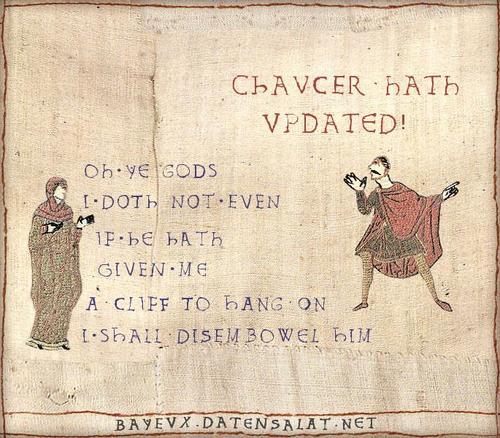
how is it possible to love fictional characters this much and also have people always been this way?
like, did queen elizabeth lie in bed late sometimes thinking ‘VERILY I CANNOT EVEN FOR MERCUTIO HATH SLAIN ME WITH FEELS’
was caesar like ‘ET TU ODYSSEUS’
sometimes i wonder
the answer is yes they did. there’s a lot of research about the highly emotional reactions to the first novels widely available in print.
here’s a thing; the printing press was invented in 1450 and whilst it was revolutionary it wasn’t very good. but then it got better over time and by the 16th century there were publications, novels, scientific journals, folios, pamphlets and newspapers all over Europe. at first most were educational or theological, or reprints of classical works.
however, novels gained in popularity, as basically what most people wanted was to read for pleasure. they became salacious, extremely dramatic, with tragic heroines and doomed love and flawed heroes (see classical literature, only more extreme.) books in the form of letters were common. sensationalism was par the course and apparently used to teach moral lessons. there was also a lot of erotica floating around.
but here’s the thing: due to the greater availability of literature and the rise of comfy furniture (i shit you not this is an actual historical fact, the 16th and 17th century was when beds and chairs got comfy) people started reading novels for pleasure, women especially. as these novels were highly emotional, they too became…highly emotional. there are loads of contemporary reports of young women especially fainting, having hysterics, or crying fits lasting for days due to the death of a character or their otp’s doomed love. they became insensible over books and characters, and were very vocal about it. men weren’t immune-there’s a long letter a middle-aged man wrote to the author of his favourite work basically saying that the novel is too sad, he can’t handle all his feels, if they don’t get together he won’t be able to go on, and his heart is already broken at the heroine’s tragic state (IIRC ehh).
conservatives at the time were seriously worried about the effects of literature on people’s mental health, and thought it damaging to both morals and society. so basically yes it is exactly like what happens on tumblr when we cry over attractive British men, only my historical theory (get me) is that their emotions were even more intense, as they hadn’t had a life of sensationalist media to numb the pain for them beforehand in the same way we do, nor did they have the giant group therapy session that is tumblr.
(don’t even get me started on the classical/early medieval dudes and their boners for the Iliad i will be here all week. suffice to say, the members of the Byzantine court used Homeric puns instead of talking normally to each other if someone who hand’t studied the classics was in the room. they had dickish fandom in-jokes. boom.)
I needed to know this.
See, we’re all just the current steps in a time-honored tradition! (And this post is good to read along with Affectingly’s post this week about old-school-fandom-and-history-and-stuff.
Ancient Iliad fandom is intense
Alexander the Great and and his boyfriend totally RPed Achilles and Patroclus. Alexander shipped that hard. (It’s possible that this story is apocryphal, but that would just mean that ancient historians were writing RPS about Alexander and Hephaestion RPing Iliad slash and honestly that’s just as good).
And then there’s this gem from Plato:
“Very different was the reward of the true love of Achilles towards his lover Patroclus – his lover and not his love (the notion that Patroclus was the beloved one is a foolish error into which Aeschylus has fallen, for Achilles was surely the fairer of the two, fairer also than all the other heroes; and, as Homer informs us, he was still beardless, and younger far)” – Symposium
That’s right: 4th Century BCE arguments about who topped. Nihil novi sub sole my friends.
More on this glorious subject from people who know way more than I do
Also a thing with fix-it/everyone lives AUs: at various points in time but especially in the mid 1800s-early 1900s (aka roughly Victorian though there were periods of this earlier as well) a huge thing was to “fix” Shakespeare (as well as most theater/novels) to be in line with current morality. Good characters live, bad characters are terribly punished – but not, you know, grusomely, because what would the ladies think? So you have like, productions of King Lear where Cordelia lives and so do Regan and Goneril, but they’re VERY SORRY.
Aka all your problematic faves are redeemed and Everyone Lives! AUs for every protag.
Slightly tangential but I wanted to add my own favorite account of Chinese fandom to this~ I don’t know how many people here have heard of the Chinese novel A Dream of Red Mansions (红楼梦), but it is, arguably, the most famous Chinese novel ever written (There are four Chinese novel classics and A Dream of Red Mansions is considered the top of that list). It was written during the Qing dynasty by 曹雪芹, but became a banned book due to its critique of societal institutions and pro-democracy themes. As a result, the original ending of the book was lost and only the first 80 chapters remained. There are quite a few versions of how the current ending of the book came to be, but one of them is basically about how He Shen, one of Emperor Qian Long’s most powerful advisers, was such a super-fan of the book, he hired two writers to archive and reform the novel from the few remaining manuscripts there were. In order to convince the Emperor to remove the ban on the book, he had the writers essentially write a fanfiction ending to the book that would mitigate the anti-establishment themes. However, He Shen thought that the first version of the ending was too tragic (even though the whole book is basically a tragedy) so he had the writers go back and write a happier ending for him (the current final 40 chapters). He then presented the book to the Emperor and successfully convinced him to remove the ban on the book.
According to incomplete estimates, A Dream of Red Mansions spawned over 20 spin offs, retellings, and alternate versions (in the form of operas, plays, etc.) during the Qing Dynasty alone.
In 1979, fans (albeit academic ones) started publishing a bi-monthly journal dedicated to analysis (read: meta) on A Dream of Red Mansions. In fact, the novel’s fandom is so vast and qualified and rooted in academics of Chinese literature that there is an entire field of study (beginning in the Qing dynasty) of just this one novel, called 红学. Think of it as Shakespearean studies, but only on one play. This field of study has schools of thought and specific specializations (as in: Psych analyses, Economics analyses, Historical analyses, etc.) that span pretty much every academic field anyone can think of.
(That being said, I’ve read A Dream of Red Mansions and can honestly say that I’ve never read its peer in either English or Chinese. If for nothing else, read it because you would never otherwise believe that a man from the Qing dynasty could write such a heart-breakingly feminist novel with such a diverse cast of female characters given all the bitching and moaning we hear from male content-creators nowadays)
the beauty of archival research *sigh*
i went to a building that is a “fan recreation” of one of the buildings from Hongloumeng and my like bitter, angry, never smiled once 78yo male teacher was like squeeing and giggling and kept sitting down and fanning himself and posed dramatically for photos
this guy was like the voldemort of staff, a man of legendary terror-inspiring mien. swooning.
A more recent example of fandom in history is the original Sherlock Holmes fan base! It’s one of the earliest coherent models we have that closely represents the fandoms of modern media.
Arthur Conan Doyle’s first two Sherlock Holmes novels weren’t hugely popular, but when he began to write stories for The Strand magazine involving Sherlock Holmes, the public basically went absolutely mental. He used to get fan mail – predominantly from women, apparently – addressed directly to Sherlock Holmes, some women even offering to be his housekeeper.
He eventually got so fed up of writing stories about a character he didn’t really like (he considered Sherlock Holmes to be an irritating distraction from his ambition to write historical fiction, once saying “he takes my mind from better things”) that he took measures to end the series once and for all. First, he raised his fee for writing the stories to an extortionate amount, hoping that the magazine would refuse to pay it and fire him. However, there was such a demand for new Sherlock Holmes stories that the magazine just agreed to pay his ridiculous fee. So, he killed off Sherlock Holmes in 1893 in the Reichenbach Falls, and when he did that, shit hit the fan. People reportedly placed Sherlock Holmes obituaries in newspapers. Many of them cancelled their subscription to The Strand, and wrote angry letters to Arthur Conan Doyle explaining how he’d broken their heart. To fill the gap left by the death of their bb, some people wrote fan fiction and shared it in literary groups and book clubs.
Conan Doyle caved to pressure in 1901 and wrote Hound of the Baskervilles, partly because the fan fervour never really died down, and partly because cash dollah. You know how fans lobbied for the return of Firefly, and ended up getting Serenity made? The original Sherlock Holmes fans totally got there first.
 ealdor