Serious posts aren’t really my bag anymore and, like, reactionaries labeling trans women some kind of rape risk isn’t exactly a new phenomenon, but something that’s really evil is when that rhetoric is coupled with a push for carcerality, as if that somehow legitimates it.
I’ve written about this before, but I want to distill how to overwrite that kind of propaganda and fear-mongering with, like, Actual Facts into one post. These are the two most common lies you’ll hear, as well as how to expose them:
”A 2017 study by Fair Play for Women found that 41% of incarcerated trans women are sex offenders.”
Fair Play for Women has an explicitly anti-trans agenda. Any research from them is fundamentally biased.
The so-called ‘study’ was timed as propaganda against amending the 2004 Gender Recognition Act to remove psychiatric clearance as a requirement for changing gender markers.
The ‘study’ falsified the number of incarcerated trans women. They claim there are 113 trans women incarcerated in England and Wales–the only official report from the Ministry of Justice, however, says there are only 70 prisoners of any trans identity.
FPfW claimed to have independently ‘identified’ incarcerated trans women from prison reports. No such records exist, and FPfW did not explain what criteria they used.
There are no reports breaking down the types of offenses committed for which trans women are incarcerated. Even FPfW acknowledges this.
Their evaluation is based on the assumption that all inmates of eight prisons are sex offenders. This is false. Only five of the eight house sex offenders, and most of the prisons also house vulnerable prisoners in mixed units.
Many kinds of sex work are criminalized as ‘sex offenses’ in England and Wales. Even if trans women are convicted for sex offenses at higher rates than cis women, that doesn’t imply sexual violence.
“The 2011 Swedish study found that trans women exhibit a ‘male pattern of criminality’, proving they’re a rape risk!”
The study is divided into two cohorts, from 1973-1988 and 1989-2003. The so called ‘male pattern’ disappears completely in the more recent cohort.
Cecilia Dhejne, primary author of the study, is on record with Trans Advocate clarifying this is not in any way what their results suggest and expressing extreme frustration at the way her research has been misrepresented.
Again, there has been no review of criminalized behaviors for which trans women are incarcerated.
Dhejne believes conviction rates among trans women reflect criminalized behaviors associated with marginality and poverty—including sex work—not sexual assaults against cis women and girls.
Trans women are already parsed as men by the carceral system. This is why they’re often sent to men’s prisons, where they experience horrific physical and sexual abuse by guards and other incarcerated people.
Other women, for comparison, are often given a pardon for sexual abuse. Case in point, current US legal precedent–set in 1993 by Hermesmann v. Seyer–is that non-trans women are entitled to child support from victims of statutory rape.
More generally, ‘criminality’ is a morally bankrupt metric to begin with. It’s not a metric of crimes committed–only of conviction rates, which reflect marginality, not the moral character of incarcerated people and certainly not ‘criminal predisposition’. Reliance on a carceral system that exists solely to uphold systemic oppression is sexist, classist, homophobic, and above all disgustingly racist.
We can’t allow lies and propaganda like this to be circulated, certainly not now that the Trump administration has effectively declared open season on trans women. Especially if you aren’t a trans woman yourself, it’s your responsibility to engage with reactionaries on our behalf whenever you see this rhetoric being disseminated or even just espoused by anyone in your community.
yknow if romeo had just Cried on juliets corpse for a couple hours instead of drinking poison Right Then they would have been Fine
The moral of the story is: always take time to cry for a few hours before making important decisions.
So I’m more or less being facetious here, but this is actually a thing.
Hamlet is genre savvy. Hamlet knows how Tragedies work, and he’s not going to rush in and get stabby without making absolutely certain he’s got all the facts.
Except once he thinks he has all the facts – once he’s certain that it really is the ghost of his father and Claudius really did kill him, he rushes in and stabs the wrong guy, which starts a domino line of deaths and gets Laertes embroiled in his own revenge tragedy and ultimately results in the deaths of nearly every character other than Horatio.
That’s the irony and the tragedy of the story. Hamlet knows his tropes and actively tries to avoid them, and the tropes get him anyway. It’s inevitable, the tropes are hungry.
I want a sticker that says the tropes are hungry so I can put it on my laptop
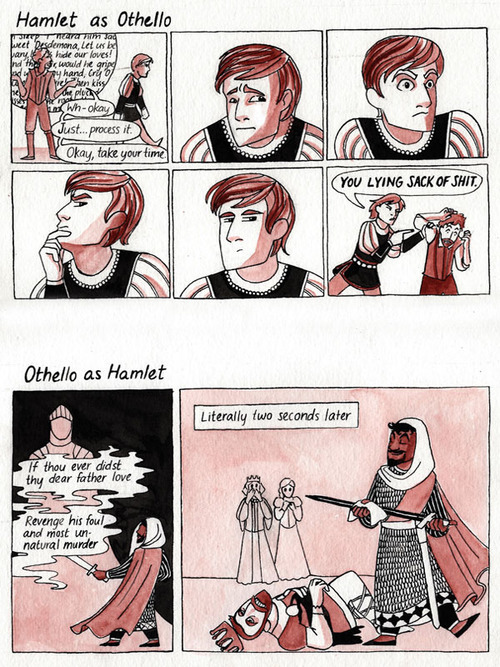
i met a scholar once who said that tragedies aren’t about a silly “flaw” or anything, it’s about having a hero who’s just in the wrong goddamn story
if hamlet swapped places with othello he wouldn’t be duped by any of iago’s shit, he’d sit down & have a good think & actually examine the facts before taking action. meanwhile in denmark, othello would have killed claudius before act 2 could even start. but instead nope, they’re both in situations where their greatest strengths are totally useless and now we’ve got all these bodies to bury.
The tropes are hungry and the hero is in the wrong goddamn story.
From @monkandbean: “That time I was working on my vampireness 🧛🏿♀️(is that even a word?), but was distracted by a leaf #ohlook #aleaf #icantstayfocused 👹🍃🍂 . CLOAK BY: @nolababies” #catsofinstagram [source: https://ift.tt/2FEfeca ]
Brunch’ish I liked all 3 versions.. There is something about the third one, more naturalistic that I really like.. but I like the sunny ones too! #pascalcampion





 ealdor